
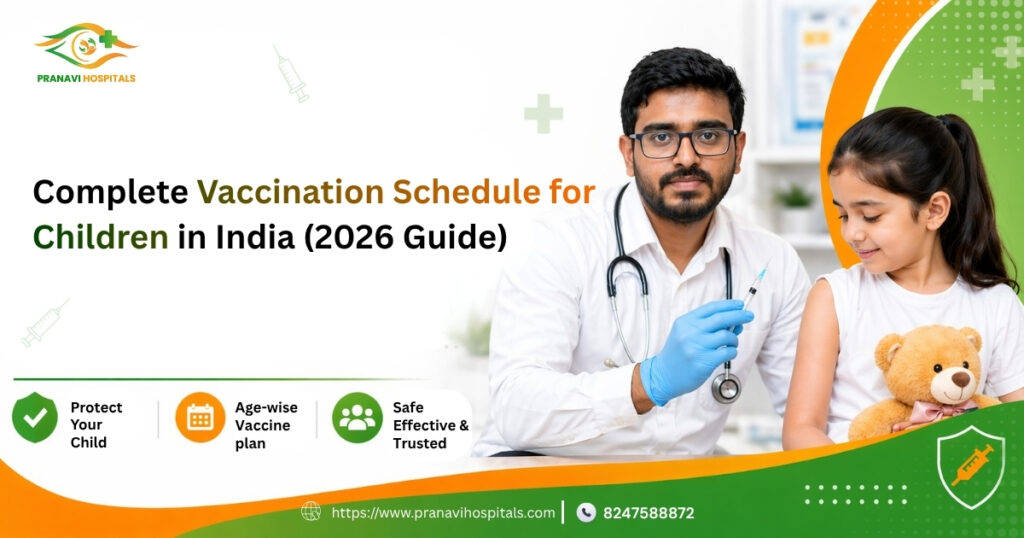
Vaccination happens to be among the most potent means of protecting children from illnesses that can endanger their lives. Since children come into the world with an undeveloped immune system, they have a greater risk of catching illnesses. For this reason, vaccines are highly significant to help boost their immunity
In India, childhood vaccination is guided by a well-maintained schedule recommended by pediatric experts and public health authorities. This schedule ensures that children receive the right vaccines at the right time for maximum protection. However, there are many parents who still have questions about vaccine timing, safety, optional vaccines, and what to do if a vaccine dose is missed.
If you are a parent looking for clarity, this vaccination guide will walk you through the complete vaccination schedule for children, along with important tips and side effects about the vaccination.
What is Vaccination and Why is it Important?
Vaccination is the process of injecting a vaccine to help the body develop immunity against specific diseases. Vaccines contain weakened or inactive parts of a virus or bacteria, which trigger the immune system to respond without causing the disease itself.
How Vaccines Work in the Body
When a vaccine is given, it stimulates the body’s immune system to produce antibodies. These antibodies help fight off infections and remember the disease. If the child is exposed to the same infection in the future, the immune system can quickly recognize and destroy it.
This process is similar to natural infection but without the risks and complications related to the disease.
Importance of Vaccination in Childhood
Vaccination protects children from serious illnesses or diseases such as:
- Polio, which can cause permanent paralysis
- Measles, which can lead to severe complications
- Tuberculosis, a serious lung infection
- Hepatitis B, which affects the liver
According to the World Health Organization (WHO), immunization prevents millions of deaths every year and is one of the most cost-effective health interventions worldwide.
In addition to protecting individual children, vaccines also help build herd immunity, which reduces the spread of diseases within communities.
Age-Wise Vaccination Schedule for Children in India (2026)
Following the correct vaccination schedule ensures that your child receives timely protection during their most vulnerable stages. Below is a complete age-wise vaccination guide for children in India (2026) recommended by pediatric experts.
1. Vaccines at Birth (Within 24 Hours)
Right after the birth, babies receive their first vaccines to protect against serious early-life infections:
- BCG: Protects against tuberculosis
- OPV (Zero Dose): Protects against polio
- Hepatitis B (1st Dose): Protects against liver infection
These vaccines are usually administered within the first 24 hours after birth.
2. Vaccines at 6 Weeks
At 6 weeks, multiple vaccines are introduced to build early immunity:
- DPwT/DTap(1st Dose): Protects against diphtheria, pertussis, and tetanus
- IPV (1st Dose): Inactivated polio vaccine
- Hib (1st Dose): Protects against meningitis and pneumonia
- Rotavirus (1st Dose): Prevents severe diarrhea
- PCV (1st Dose): Protects against pneumococcal infections
3. Vaccines at 10 Weeks
The second round strengthens the protection:
-
- DPwT/DTap (2nd Dose)
- IPV (2nd Dose)
- Hib (2nd Dose)
- Rotavirus (2nd Dose)
- PCV (2nd Dose)
4. Vaccines at 14 Weeks
At this stage, third doses are given for stronger immunity:
- DPwT/DTap (3rd Dose)
- IPV (3rd Dose)
- Hib (3rd Dose)
- Rotavirus (3rd Dose)
- PCV (3rd Dose)
5. Vaccines at 6 Months
- Hepatitis B (3rd Dose) – Ensures long-term protection against hepatitis B
6. Vaccines at 9 Months
-
- Measles or MMR (1st Dose): Protects against measles, mumps, and rubella
- Typhoid conjugate vaccine
This vaccine is crucial to prevent complications like pneumonia and brain infections.
7. Vaccines at 12-15 Months
- MMR (2nd Dose)
- PCV Booster
8. Vaccines at 16-18 Months
- DPT Booster
- IPV Booster
Booster doses help maintain immunity as your child grows.
9. Vaccines at 2 Years and Above
- Typhoid Vaccine: Protects against typhoid fever
10. Vaccines at 4-6 Years
-
- DPT Booster
- MMR (3rd Dose)
- Varicella
11. Vaccines at 10-16 Years
- Tdap or Td Booster: Protects against tetanus and diphtheria
Government vs Private Vaccines in India- What Parents Should Know
In India, children’s vaccines are divided into two main categories: government-provided (free) vaccines and optional vaccines available in private healthcare settings and hospitals. Understanding this difference helps parents make informed decisions about their child’s complete health and immunity protection.
Government (Free) Vaccines Under the UIP Program
The Government of India provides essential vaccines through the Universal Immunization Programme (UIP), one of the largest public health initiatives in the world.
These vaccines are free of cost and are available at government hospitals, primary health centers, and Anganwadi centers all around India.
Common Government Vaccines Include:
- BCG: Protects against tuberculosis
- OPV (Oral Polio Vaccine): Prevents polio
- DPT: Protects against diphtheria, pertussis, and tetanus
- Measles vaccine: Prevents measles infection
These vaccines focus on protecting children from high-risk and life-threatening diseases that are more common in developing regions.
Important Note: Government vaccines are safe, effective, and follow national health guidelines.
Optional Vaccines (Recommended by Pediatricians)
Optional vaccines are not part of the free government program but are strongly recommended by pediatricians for additional protection of children’s health.
These vaccines are usually available in private hospitals and clinics.
Common Optional Vaccines:
- Chickenpox (Varicella vaccine)
- Hepatitis A vaccine
- Influenza (Flu vaccine)
- HPV (Human Papillomavirus vaccine)
These vaccines help protect children from infections that may not be covered under the government schedule but can still cause serious health issues.
Why Consider Optional Vaccines?
- Provide broader protection
- Reduce risks of hospitalization and illness
- Improve long-term health outcomes
Common Side Effects of Vaccines in Children
Vaccines are thoroughly tested for safety and are generally well-tolerated by children. However, mild side effects may occur as the body builds immunity.
Normal and Temporary Side Effects
After vaccination, some children may experience mild symptoms such as:
- Low-grade fever
- Pain, redness, or swelling at the injection site
- Mild irritability or fussiness
- Sleepiness or reduced appetite
These reactions are completely normal and usually settle down within 24 to 48 hours. These signs indicate that the vaccine is working and the immune system is responding.
When Should You Consult a Doctor?
Although very rare, some symptoms require immediate medical attention.
Seek medical help if your child has:
- High fever (above 102°F or 39°C)
- Continuous crying for more than 3 hours
- Severe swelling or redness
- Allergic reactions such as rash, vomiting, or breathing difficulty
Important: Serious side effects are extremely rare, but ensure timely medical care if they occur.
What Happens If You Miss a Vaccine Dose?
Missing a vaccine dose is quite common due to illness, travel, or other unavoidable reasons. However, delaying vaccination for a long time can leave your child unprotected against infections.
Catch-Up Vaccination Schedule Explained
If your child misses a scheduled vaccine, pediatricians can create a catch-up vaccination plan to ensure complete immunization.
Key Points About Catch-Up Vaccination:
- No need to restart the entire schedule
- Missed doses can be adjusted safely
- Protection can still be achieved with proper guidance
Key Takeaway: It is never too late to continue or restart your child’s vaccination under a doctor’s supervision.
Important Tips for Parents Before and After Vaccination
Proper care before and after vaccination can make the experience smoother and reduce discomfort for your child.
Before Vaccination
- Ensure your child is active and healthy
- Inform the doctor about any allergies or previous reactions
- Carry your child’s vaccination record/card
- Dress your child in comfortable clothing
After Vaccination
- Monitor your child for fever or swelling
- Apply a cold compress if needed (as advised by the doctor)
- Give medications only if prescribed
- Keep your child well-hydrated and comfortable
Common Myths Parents Should Avoid
- Skipping vaccines due to a mild cold or fever
- Believing vaccines weaken immunity
- Delaying vaccines unnecessarily
Most vaccines can be safely given even if your child has a mild illness.
Why Choose a Pediatrician for Your Child’s Vaccination?
Vaccination is not just about giving an injection; it requires proper timing, monitoring, and expert care. A qualified pediatrician ensures your child receives vaccines safely and correctly.
Benefits of Pediatrician-Guided Vaccination
- Accurate vaccination schedule tracking
- Safe and hygienic administration
- Immediate care in case of side effects
- Personalized vaccine recommendations
At Pranavi Children’s and Eye Hospital in Kandukuru, we provide complete pediatric care and vaccination services, ensuring your child receives the best protection at every stage of their growth.
How to Choose the Best Pediatrician for Vaccination
Choosing the right pediatrician is essential to ensure your child receives vaccines safely and on time. Look for a doctor with experience in child healthcare, up-to-date knowledge of vaccination schedules, and a focus on hygiene and safety of the child. A good pediatrician will also take time to explain the process and address your concerns. At Pranavi Children’s and Eye Hospital, Dr. K. Naveen Kumar provides trusted vaccination guidance with a patient-friendly approach, helping parents stay confident and informed throughout their child’s immunization journey.
FAQ
1. Is it safe to follow the vaccination schedule in India?
Yes, the vaccination schedule used in India is safe and recommended by pediatric experts and global health authorities, including the World Health Organization. It is designed to protect children at the right age when they are most vulnerable.
2. What happens if I delay my child’s vaccination?
Delaying vaccination can leave your child unprotected against serious diseases. However, you can consult a pediatrician for a catch-up vaccination schedule to safely continue from where you stopped.
3. Are optional vaccines really necessary for my child?
Optional vaccines are not mandatory but are highly recommended as they provide additional protection against infections like flu, hepatitis A, and chickenpox.
4. Can my child get vaccinated if they have a cold or mild fever?
Yes, in most cases, mild illnesses like a cold or low-grade fever do not prevent vaccination. However, it is always best to consult your pediatrician before proceeding.
5. Are multiple vaccines given at the same time safe?
Yes, giving multiple vaccines during the same visit is safe and effective. It reduces the number of hospital visits and ensures timely protection.
6. What are the common side effects after vaccination?
Common side effects include mild fever, swelling at the injection site, and irritability. These are temporary and usually resolve within 1–2 days.
7. How do I know if my child is fully vaccinated?
Your pediatrician will maintain a vaccination record and guide you based on the recommended schedule. Keeping a vaccination card or digital record helps track all doses.
8. Do vaccines cause any long-term health problems?
No, vaccines are thoroughly tested for safety and do not cause long-term health issues. They are one of the safest and most effective ways to prevent diseases.
9. How often should my child visit a pediatrician for vaccination?
Your child should visit according to the vaccination schedule (birth, 6 weeks, 10 weeks, etc.). Regular visits ensure timely doses and proper monitoring.
10. Which is better: government vaccination or private vaccination?
Both are safe and effective. Government vaccines cover essential diseases, while private vaccines provide additional protection. A pediatrician can guide you on the best choice for your child.
11. Does Pranavi Children’s and Eye Hospital in Kandukur provide vaccination services?
Yes, Pranavi Children’s and Eyes Hospital in Kandukur offers complete vaccination services for children, following the recommended immunization schedule in India.
12. Which is the best hospital for child vaccination in Kandukur?
Pranavi Children’s and Eye Hospital is a trusted choice for many parents, offering expert pediatric care and a child-friendly environment for safe, timely vaccinations.
Conclusion
Vaccination plays a crucial role in protecting your child from serious diseases and ensuring healthy growth. By following the recommended vaccination schedule in India, parents can provide timely immunity during the most important stages of development.
Staying consistent with vaccine schedules, keeping proper records, and consulting a qualified pediatrician can make a significant difference in your child’s long-term health.
At Pranavi Children’s and Eye Hospital, we provide safe and expert vaccination care to support your child’s healthy future. If you have any questions or need guidance, consult our pediatric team to ensure your child stays protected at every stage.